보도자료
보도자료
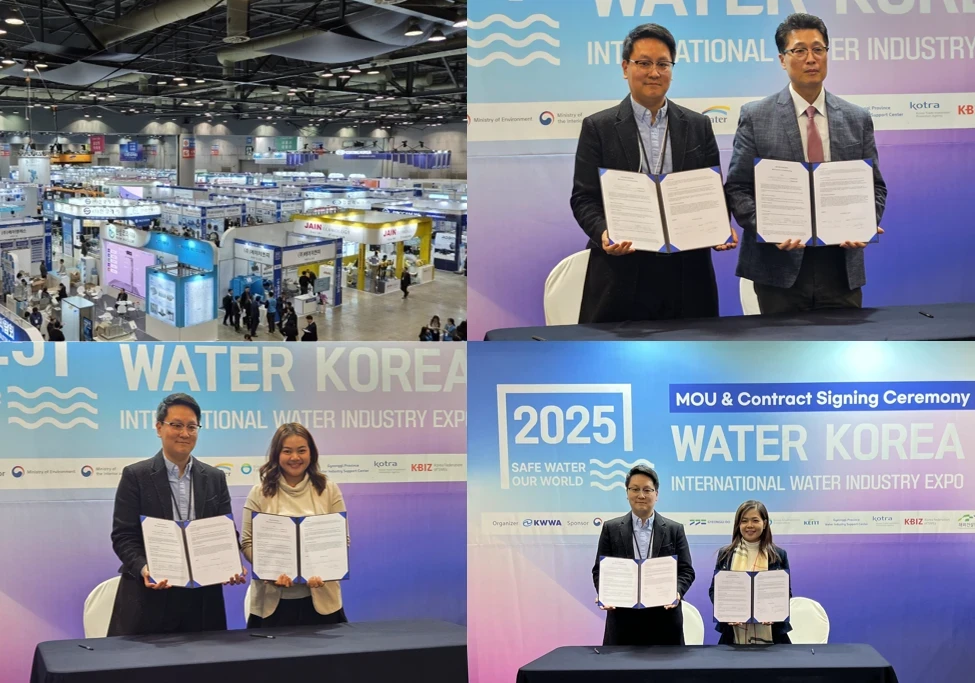
GeoGrid Signs MOUs with Three Asian Companies at “Water Korea 2025”
GeoGrid Signs MOUs with Three Asian Companies at “Water Korea 2025”
2025. 4. 1.
2025. 4. 1.
In a Korean water environment where showerhead filter use has become routine and bottled water consumption continues to rise, one company is taking on the challenge of restoring trust in tap water through technology. GeoGrid, based at Samsung Electronics’ Seoul R&D Campus in Seocho-gu, is developing BLOS (Building Oasis), a building-scale water quality management solution that supplies drinking-quality water from every tap without replacing existing building pipes, offering an alternative for Korea’s urban water environment.
Inside GeoGrid’s office, multiple monitors display real-time water quality data from each building, while pipe cross-section samples and analysis materials fill the workspace. CEO Kihyun Kim places two pipes side by side, one an iron pipe corroded into a reddish color, and the other showing a dark protective layer formed after applying BLOS technology. He explains, “The core problem is that even purified water can become contaminated again as it passes through aging pipes.”
Improving water quality without replacing pipes
In Korea, aging pipes that are more than 20 years old total approximately 95,000 km, and replacing them requires substantial cost and disruptive construction. To address this structural limitation, GeoGrid developed a water quality improvement approach that does not require pipe replacement.
Pointing to a full-scale BLOS unit installed in the office, Kim explains how it works. “BLOS purifies water through physical and electrical methods without chemicals, and forms a magnetite-based protective layer that helps suppress pipe corrosion. Depending on the building, internal contamination typically improves and stabilizes within about two weeks to two months.”
With this approach, GeoGrid is proposing a new model of water innovation, replacing the conventional assumption of “pipe replacement” with “data-driven management technology.”
Building trust through real-time data
GeoGrid defines BLOS not as a standalone purification device, but as an urban water infrastructure solution. Users and building operators can check water quality indicators, water usage, and pipe conditions in real time via smartphone or PC.
Kim says, “Invisible change only matters when it becomes trust. Real-time data provides transparency and objectivity, which can lead to meaningful changes in user behavior.”
Through its proprietary Water-BEMS (Building Water Energy Management System), GeoGrid is building an integrated management system that helps maintain optimal water conditions across an entire building.
From everyday spaces to city infrastructure
GeoGrid has accumulated real-world results by deploying BLOS across apartments, schools, hospitals, resorts, and other facilities. In particular, performance outcomes in public settings such as aging school cafeterias and welfare facilities for vulnerable groups demonstrate how the technology can create social value.
At a high school in Gyeonggi-do, after BLOS installation, the general bacteria count, previously around 120 CFU/mL, improved to below the regulatory threshold, significantly increasing satisfaction among students and parents.
Kim emphasizes, “What matters most is not the technology itself, but the change and safety it delivers. Creating water that children can drink with confidence is the most fundamental value GeoGrid pursues.”
He also notes, “Premium hospitality facilities such as hotels and resorts will increasingly differentiate themselves by the quality of their water,” projecting that urban water infrastructure technology will open up new market value.
Toward cities where tap water can be trusted again
GeoGrid is focusing on fundamental urban challenges beyond purification alone, including addressing aging pipes and restoring public trust in tap water. Its pipe-replacement-free improvement technology, trust building through transparent data, and validation across both public and private sites are forming the foundation of what GeoGrid calls “water welfare.”
Closing the interview, Kim said, “Good water should be a basic standard, not a choice. What we build is not simply about fixing pipes. It is about rebuilding the water culture of buildings and cities.”
Source: MoneyToday (https://www.mt.co.kr/industry/2025/03/25/2025032510250612132)
In a Korean water environment where showerhead filter use has become routine and bottled water consumption continues to rise, one company is taking on the challenge of restoring trust in tap water through technology. GeoGrid, based at Samsung Electronics’ Seoul R&D Campus in Seocho-gu, is developing BLOS (Building Oasis), a building-scale water quality management solution that supplies drinking-quality water from every tap without replacing existing building pipes, offering an alternative for Korea’s urban water environment.
Inside GeoGrid’s office, multiple monitors display real-time water quality data from each building, while pipe cross-section samples and analysis materials fill the workspace. CEO Kihyun Kim places two pipes side by side, one an iron pipe corroded into a reddish color, and the other showing a dark protective layer formed after applying BLOS technology. He explains, “The core problem is that even purified water can become contaminated again as it passes through aging pipes.”
Improving water quality without replacing pipes
In Korea, aging pipes that are more than 20 years old total approximately 95,000 km, and replacing them requires substantial cost and disruptive construction. To address this structural limitation, GeoGrid developed a water quality improvement approach that does not require pipe replacement.
Pointing to a full-scale BLOS unit installed in the office, Kim explains how it works. “BLOS purifies water through physical and electrical methods without chemicals, and forms a magnetite-based protective layer that helps suppress pipe corrosion. Depending on the building, internal contamination typically improves and stabilizes within about two weeks to two months.”
With this approach, GeoGrid is proposing a new model of water innovation, replacing the conventional assumption of “pipe replacement” with “data-driven management technology.”
Building trust through real-time data
GeoGrid defines BLOS not as a standalone purification device, but as an urban water infrastructure solution. Users and building operators can check water quality indicators, water usage, and pipe conditions in real time via smartphone or PC.
Kim says, “Invisible change only matters when it becomes trust. Real-time data provides transparency and objectivity, which can lead to meaningful changes in user behavior.”
Through its proprietary Water-BEMS (Building Water Energy Management System), GeoGrid is building an integrated management system that helps maintain optimal water conditions across an entire building.
From everyday spaces to city infrastructure
GeoGrid has accumulated real-world results by deploying BLOS across apartments, schools, hospitals, resorts, and other facilities. In particular, performance outcomes in public settings such as aging school cafeterias and welfare facilities for vulnerable groups demonstrate how the technology can create social value.
At a high school in Gyeonggi-do, after BLOS installation, the general bacteria count, previously around 120 CFU/mL, improved to below the regulatory threshold, significantly increasing satisfaction among students and parents.
Kim emphasizes, “What matters most is not the technology itself, but the change and safety it delivers. Creating water that children can drink with confidence is the most fundamental value GeoGrid pursues.”
He also notes, “Premium hospitality facilities such as hotels and resorts will increasingly differentiate themselves by the quality of their water,” projecting that urban water infrastructure technology will open up new market value.
Toward cities where tap water can be trusted again
GeoGrid is focusing on fundamental urban challenges beyond purification alone, including addressing aging pipes and restoring public trust in tap water. Its pipe-replacement-free improvement technology, trust building through transparent data, and validation across both public and private sites are forming the foundation of what GeoGrid calls “water welfare.”
Closing the interview, Kim said, “Good water should be a basic standard, not a choice. What we build is not simply about fixing pipes. It is about rebuilding the water culture of buildings and cities.”
Source: MoneyToday (https://www.mt.co.kr/industry/2025/03/25/2025032510250612132)

Copyright Ⓒ 2025 GEOGRID co., Ltd
Tel. +82-31-699-3404
솔루션
서비스
인사이트
기업정보
미디어
고객지원